It Is Finished
It's crazy how you can find yourself at the start of a new journey.

It’s done.
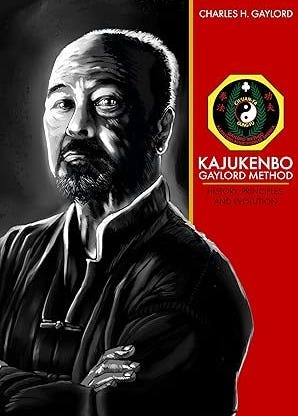
A couple weeks ago I finished my third book project: a co-authored update and revision of Charles Gaylord’s 2003 book. I spent the last couple of years with my Kaju brother, Kekoa Hubbard, on this project. Success.
We had our work cut out for us. The original book, meant for Gaylord Method students, outlined most of our curriculum and explained the known history of Kajukenbo at the time. That history had been shared among all branches of Kajukenbo and Gaylord had written down what he’d been taught. The thing is, that history would be found to be full of inaccuracies and mistakes over the next couple decades, and the curriculum in the book was incomplete. Gaylord himself passed in 2009. On that note, a few years ago the KAA asked Kekoa and I to edit the book and fill in the holes left by our modern understanding of our history.
So we did. We started looking more and more at the history written down by the likes of record keepers like Mitch Powell, Al Dacascos, Dave Tavares, and John Bishop. What started as a basic volunteer editing job developed into a revised handbook that outlines all the rules, etiquette, history, and curriculum of our branch of Kajukenbo, and I thank Kekoa for pushing us to make that happen.
We added biographies on other key people of the Kajukenbo and Chuán Fa history: Joseph Emperado, who was murdered at the Pink Elephant Bar, and George Seronio, who Gaylord considered his direct teacher in a way that only a martial artist can understand, and James Juarez, who expanded our system and wrote texts of his own to better explain Gaylord’s method, and Melcor Chavez, who’s worked for decades to help the communities of New Mexico and added his own training to accent that of the Gaylord Method. We just about doubled the size of the book. It became a manual that we hope all students can use now and in the future.
And it’s all made me reflect on who I am as a Kajukenbo practitioner.
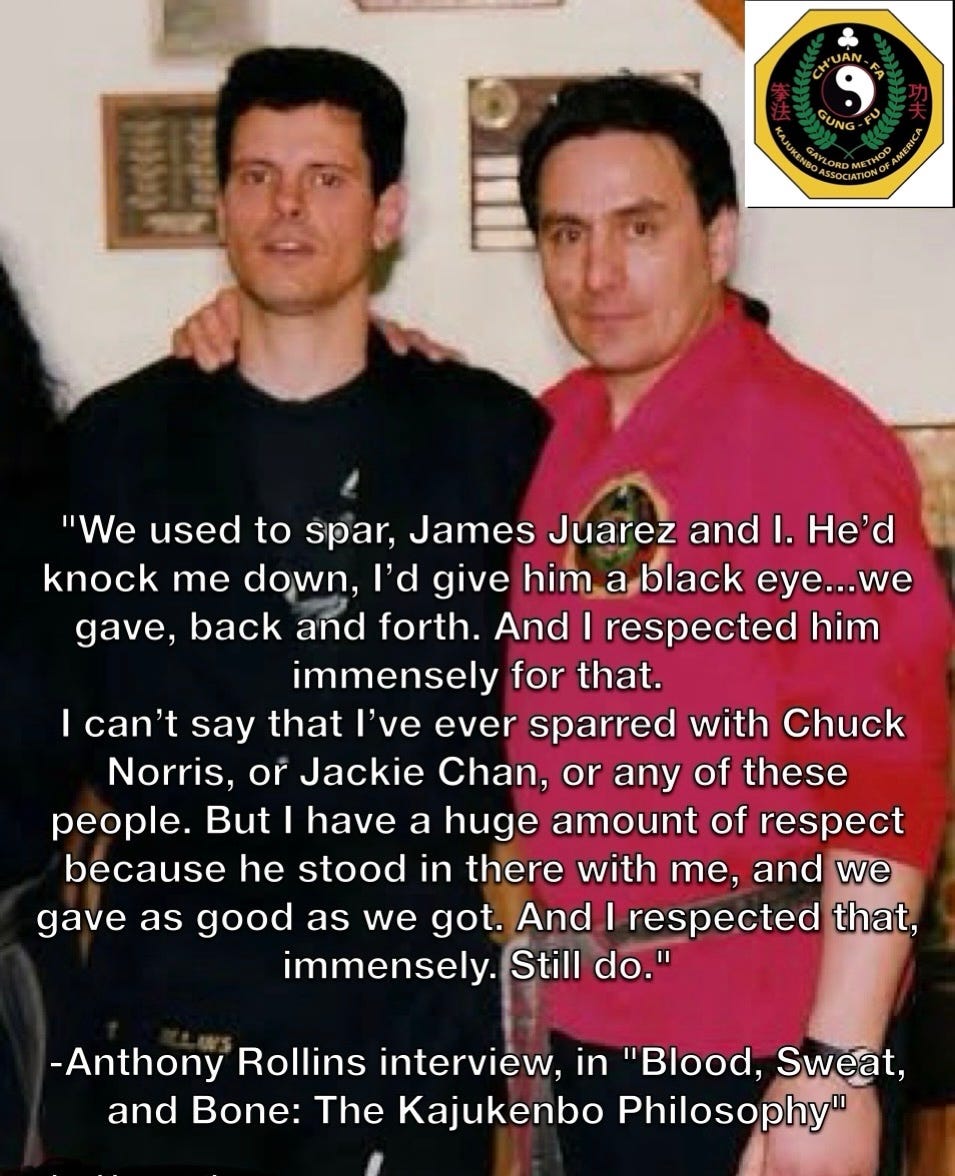
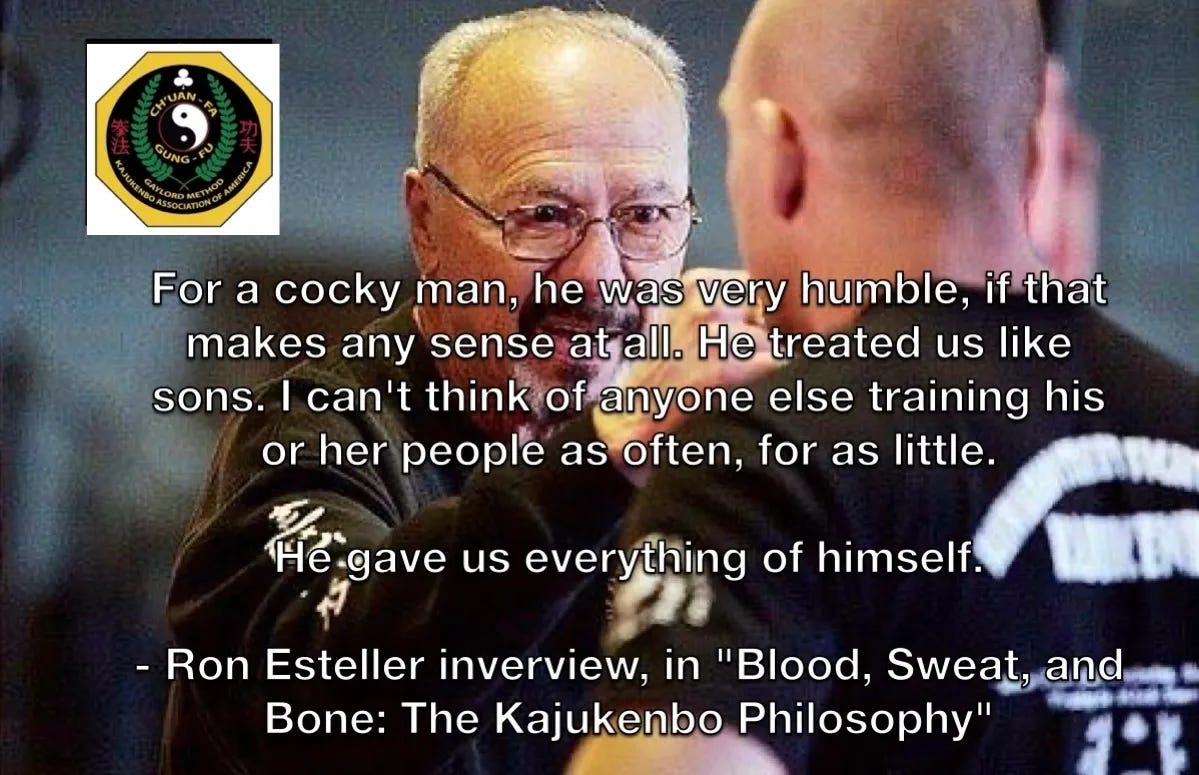
I’ve told the story countless times of my martial art history - McDojo instructor after McDojo instructor, until I found Ron Esteller and Kajukenbo. That changed my life. It was also my connection to his instructor, James Juarez, who took what Sifu Ron had taught me and expanded it in so many ways. I had found a martial art home in training with Sifu Ron and Sigung Juarez, and it formed the person I am today.
I’m always wary of organizations because of my time in McDojos. Despite my love of Kajukenbo and utmost respect for Esteller and Juarez, I stayed away from officially joining Gaylord’s KAA, the Kajukenbo Association of America. I respected Gaylord, not only as the instructor of the two men I looked up to, but as a human being. He was a cool guy.
But I didn’t join the KAA. It just didn’t feel right to me for where I was in my life.
After Gaylord passed, the majority of people wanted Juarez to take his place as the head of our Kajukenbo branch. As would suit the humble badass I’d come to respect, it took 8 years of haranguing to get him to accept that mantle. Chavez soon after joined as a co-head of our branch, fulfilling Gaylord’s wish to have both men take the lead. Chavez’ kickboxing and Escrima training, which I got to learn through my sempai Eric Coleman, gave me a respect for Chavez that only multiplied when I met him and got to know him.
I’ll always remember the day of my kickboxing match in New Mexico, when an mma fighter (not from Kajukenbo) got upset at losing to Tom Theo’s fighter. He was so upset he shoved Chavez. He then hurriedly skulked off with his tail between his legs because half of the gymnasium had stood up to back up Chavez, a badass himself who was respected not only for his skill and experience but also for his good heart. You don’t push someone who can beat your ass when you’re surrounded by a crowd of fighters they’ve helped mentor, all because you didn’t like how you tapped out in a fight.
Somewhere in all of that, I felt it was time to join the KAA. Maybe it was because of the time I’d spent training with those involved, but eventually and for whatever reason I took the leap and joined. When I was later asked to interview the grandmasters of our branch for a YouTube series, I was happy to do that. I was then asked to join the KAA board as our Kajukenbo historian. And here I am now.
As the historian, completing this book is a huge thing - years later it feels like it makes my position official. But solidifying a friendship with Kekoa along the way was a bigger thing. I had met Kekoa years ago at Sifu Ron’s school, and when we started working on the book I found a fellow nerd I could talk shop with, not just about Kajukenbo, but other geeky stuff too, like Shadowrun, Blind Guardian, and Madripoor. Now we’re looking at our next project together. Check out Kekoa’s artwork here and here.
Am I glad I joined the KAA? I am. I still don’t trust bureaucracy, but as Eric once put it: “You can’t change things from the outside.” Besides - the people currently on the board are pretty badass in their own ways and all have my respect.
Kajukenbo is full of people who hate discussing politics and prefer direct communication to political planning. But being on this board has shown me the power of a group of good people. The world is complex. Sometimes you can punch your way through a problem, and sometimes you have to plan things together and find another way around.
This new family has shown me the value of organization, of working together at a management level. They got their shit tight. Finishing this book made me reflect on all of this, and I find it powerful that achieving a goal can do that. When you finally reach the top of the mountain, you can turn around, look back at the way you’ve come, and see a portrait most people will never see.
Then you can turn around again and climb the next mountain.
I don’t know what the future holds, but in the process of organizing the book we’ve already made positive change in Kajukenbo. Things that people complain about in our art, like the incorrect usage of titles, or false history, or too many grandmasters at the top - they can be dealt with. Change can happen, if you take a step back and find a way to make it happen. This isn’t just a lesson for the martial arts - it’s something you can take out of the dojo to the outside world.
Change can happen, and we can make a utopia.
But it sure as hell ain’t easy. Take a step back…
…and find a way to make it happen.
Check out Gaylord’s revised book, here.
And, be sure to check out my Kajukenbo Philosophy books, available here.
And Kekoa’s art here and here.